

We conceived and designed Anova with this game in mind.
In previous versions of the game, we have used real-world countries and data for our players to use. Each representing a country that they could find on a map and study through real histories and cultural events. Sometimes though, people would represent a country that they knew more about than the other players, or in extreme cases, had preconceptions or unflattering opinions about. This caused strife not only in those teams, but in the flow and spirit of the game, thus causing the game to devolve into something that it wasn’t intended to be.
Anova is meant to stand apart from the real-world. None of the countries of Anova are representative of countries in the real world and their challenges and struggles are not meant to represent any one culture as a whole. The scenarios and events that you will encounter during gameplay are inspired and even derived from real-world events that we have read about and studied, drawn from the last half century of geopolitics. We did this so that players wouldn’t approach the decisions that they are confronted with from a place of bias. Yes, some decisions will mirror what real-world governments have made, and the consequences that follow may feel familiar, but the decision that the players made to take that road will not have come from prejudice and misunderstanding.
People’s Republic of Hanan
The People’s Republic of Hanan, Hanan, or PRH is a country spanning about two thirds of the northern span of the continent of Anova. It is bordered by Parhovia to the South and Southwest, Ochor to the South and Southeast, and Pyce to the East. The Transanovan Mountains border the entire Southern border. The Neju desert, which is disputed with Pyce, lies in the Eastern part of the country and the North and West are bordered by the Savus and Nuric oceans respectively.
Hanan was a monarchy for five hundred years before the revolution fifty years ago. The revolution aimed to emulate the ideals of capitalism as was modeled by Erva at the time. Unfortunately, due to a cultural foundation of nepotism and corruption, the new system quickly fell apart. Now, most of the national utilities and industries are owned by the super-rich, often friends and relatives of the former monarchy.
The recent conflict with Pyce has turned the majority of the already disillusioned population against the government. Ideological justifications have not swayed the opinion of the Anarši majority.
The low-lying agricultural region in the West is the richest producing crop-land in Anova, and the PRH exports most of what it produces. Newly discovered mineralogical deposits off shore in the Savus East of the delta have proven to be in high-demand as well. Despite high income from mining and agriculture, there remains a high income inequality due to regional corruption and an imbalance taxation system.
The PRH has reported a population of 9.2 million, but due to the largely undeveloped regions in the Eastern part of the country, accurate counts are hard to confirm. Despite this, it is the largest and most populous country in Anova.
Emigration and climate related depopulation has contributed to a downward-trending population in recent years. The conflict with Pyce has also driven many of its younger working population South to seek more stable habitation and employment.
The PRH is a member of the West Anovan Defence Organization (WADO) along with Parhovia, Parhana and Erva. They are committed to providing military or humanitarian aide to each of the member states if they are called on. Hanan has called on its co-members for assistance against Pyce in its ongoing conflict, but member states have ruled in a majority vote that aide is not required if a member state initiates a conflict. Hanan has officially protested and threatened to pull out of WADO.

| capital | Ðavajona |
| population | 9.2 million |
| exports | minerals, agriculture |
Parhovia
Parhovia lies on the southwestern part of the Anovan continent, its western aspect toward the Nuric Ocean and the temperate climate aided by the Transanovan Mountains along the northern border makes it an ideal agricultural region. It is bordered by the PRH to the North, Ochor to the East and Parhana to the Southeast.
Parhovia used to encompass the territory that is not Parhana until ideological tensions caused a cultural rift and sparked a civil war that ended with the creation of Parhana as an independent nation thirty years ago. Ideological tensions have calmed largely on the mainland, but there are occasional flare-ups on Pjor.
Agricultural products such as wheat and wine are foundational to Parhovia’s economy. There is a rich industry of fishing off the Southern coast, but overfishing has become an issue.
The population of Parhovia has historically been stable, but with recent geopolitical and climate related issues to the North, the region surrounding Argahani has seen a marked increase.
Parhovia is a member state of WADO as well as STA.


| capital | Šanakvari |
| population | 5.1 million |
| exports | agriculture, aquaculture |
Parhana
Parhana occupies the arid southern region of Anova. It is bordered by Parhovia to the West, Ochor to the Northeast, and Erva to the East. It shares the island of Pjor with Parhovia.
Parhana is Anova’s youngest nation, formed after the resolution of the Parhovian civil war thirty years ago. Relations with its Western neighbor remain tense, but are generally civil. Erva is its closest economic partner.
Despite its arid climate, Parhana produces high quality wine and olive oil.
Because of a lack of progressive industry, Parhana suffers a negative population. Many of its younger and more educated population have migrated East to Erva and Ochor.
Parhana is a member state of WADO and STA.


| capital | Fidž |
| population | 3 million |
| exports | agriculture |
Erva
Erva is the technological hub of Anova. Its small land area belies a dense population centered on a high tech industry.
Erva’s central and southern position grants it both easy access to most of the nations of Anova in modern trade relations. Historically it has been surrounded by opposing states and developed a stance of neutrality among them.
Erva’s economy relies heavily on it’s technological exports and financial services sector. Its political neutrality is a benefit to international banking needs.
The average age of Erva’s population is under forty as it attracts many of its neighbor’s youth and educated professionals. Population growth in the already crowded territory has created housing issues though.
Erva is a member state of the STA and WADO. It’s membership in WADO has caused friction with the eastern nations of Ochor, Pyce and the Patan Confederacy as it has declared neutrality politically, but is obligated by treaty to defend PRH as an ally.

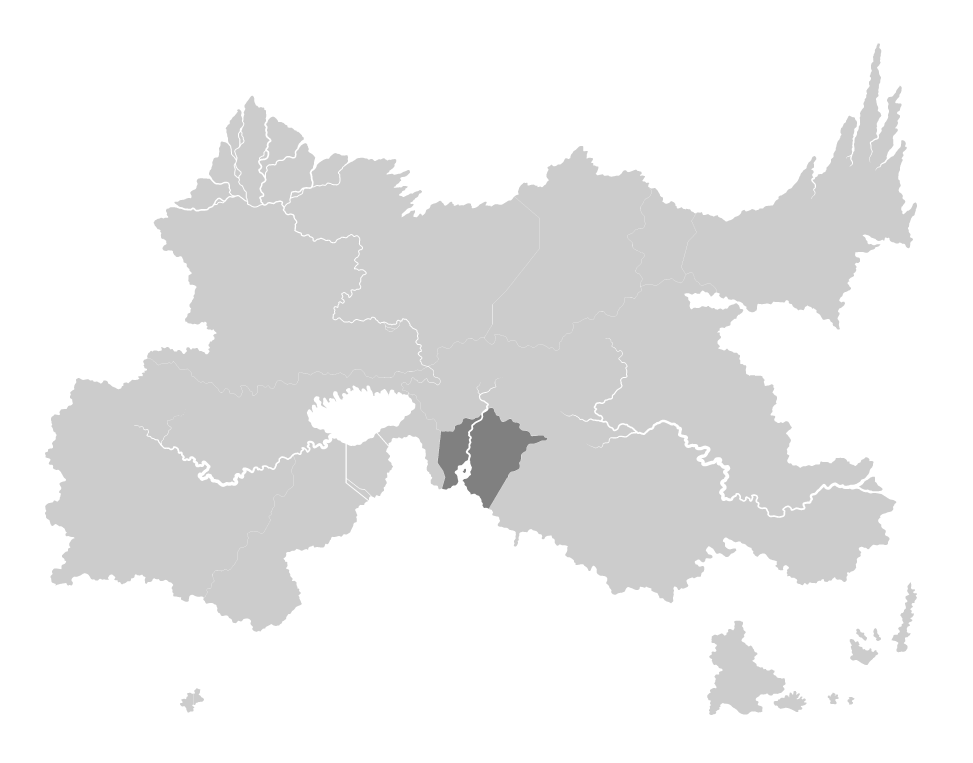
| capital | erva |
| population | 5.8 million |
| exports | finance, technology |
Ochor
Ochor holds a unique geopolitical position on Anova. It is a large and influential nation in the STA but its cultural identity is split between the southern nations and a close relationship with Pyce. It shares land borders with all of the nations of the mainland and is the closest nation to the Patan Confederacy.
Ochor’s cultural capital is Faludi and shares the metropolitan area around Pist, the capital of Pyce. The area rivals Erva in population density, and is culturally and ideologically diverse. There have been no major conflicts with any of it’s neighboring nations historically, but a small population of indigenous people claim the Ochor Pat Mountains as their homeland and are petitioning for semi-autonomy.
The southern half of Ochor is agriculturally rich and the Ochor Pat mountains are mineralogically abundant, closely tying them to the needs of Erva.
Ochor’s population trends over 45, but it’s northern region averages 25-30.
Ochor is a member state of STA.


| capital | Makhaït |
| population | 7.3 million |
| exports | minerals, agriculture |
Pyce
Pyce is the most secluded geographically from the other nations of Anova. The Nejuv Desert and an aggressive PRH to the West and a small border with Ochor to the South are its only connection to the continent. Despite this, it has developed a unique and independent culture that is largely self-dependent.
Pyce is historically a nomadic culture closely related to the ethnic groups of the Nejuv Nations. Their culture has been greatly influenced by Ochor along the southern border, and has embraced a more cosmopolitan lifestyle in the capital.
The thin band of agriculturally rich ground south of the Ban Dova Mountains is Pyce’s only producing region. The northern mountains and the sea floor off of Ana Kydav are mineralogically rich though and account for the majority of exports.
80% of the population lives within 100 kilometers of the capital Livaja. The next largest city is Ana Rynd, but population along the western border has been reduced due to current military aggression of the PRH.
Pyce is largely self sufficient and is not part of any defense or trade alliances.

| capital | livaja |
| population | 7.3 million |
| exports | minerals, agriculture |
Patan Confederacy
The Patan Confederacy is the archipelago to the southeast of the mainland of Anova. The nearest nation is Ochor.
The Patan Confederacy has historically been secluded from the mainland politically, but their culture of shipbuilding and exploration has seen them connect with many countries across Anova and beyond. They have been a unified confederacy for 150 years and due to their largely homogenous ethnicity, there is little cultural or ethnic tension.
Due to their prowess in shipbuilding and navigation, Rangupatan holds a near monopoly on shipping, providing vessels for the vast majority of sea trade along the southern and eastern Anovan coasts. Their fisheries and sea plantations are their second and third most important exports.
The Patan Confederacy is 95% indigenous, with 3% originating in Ochor and 2% from other countries across Anova.
The Patan Confederacy has applied to become a member state of STA, but its standing is currently still under review.


| capital | rangupatan |
| population | 1.9 million |
| exports | aquaculture |
Nejuv Nations
The Nejuv Nations include a handful of semi-autonomous indigenous groups scattered around and through the Neju Desert, which spans the eastern-most part of PRH and the western border of Pyce. It is currently disputed territory between the two recognized nations.
Historically, the people of the Neju Desert and its environs have been nomadic people, though they are unified ethnically and religiously by the permanent city of Ilu. Before the advent of flight, the region effectively separated Pyce and the PRH. However, during the rare earth rush of the last two decades, Pyce has taken a close interest in the area. Pyce is currently trying to annex the majority of the desert up to the area just East of Prs Belijona claiming sovereignty over the rich mineral deposits. The PHR has likewise claimed the desert encompassing Ilu on ideological grounds as their state run religion is said to originate in the city.
Aside from the recent discovery of rare earth deposits in the desert and offshore, there is no economic value to the region. The loose alliance between most groups also makes trade with other nations not currently trying to annex their land difficult.
A census of the Nejuv Nations has never been effectively performed due to its region spanning the border between Pyce and the PRH.
The western half of the Neju Desert is within the border of the PRH so it technically falls under the WADO (West Anovan Defence Organization), but the other member states have yet to act in its defense in response to any aggression from Pyce.


| capital | ilu |
| population | 640,000 |
| exports | none |
Alliances
West Anovan Defence Organization
The West Anovan Defence Organization (WADO) is a defense and aide organization including the PRH, Parhovia, Parhana and Erva.
The People’s Republic of Hanan (PRH) pushed for the formation of WADO in response to growing political, economic and military pressure directed against it from Pyce, despite the PRH’s superior resources and geopolitical influence. The organization has not been a great success and has been plagued by infighting and broken promises from the beginning. The latest issues revolving around PRH aggression toward Pyce; other member states refuse to lend assistance in their aggression due to a lack of evidence of PRH claims of initial Pycian aggression.

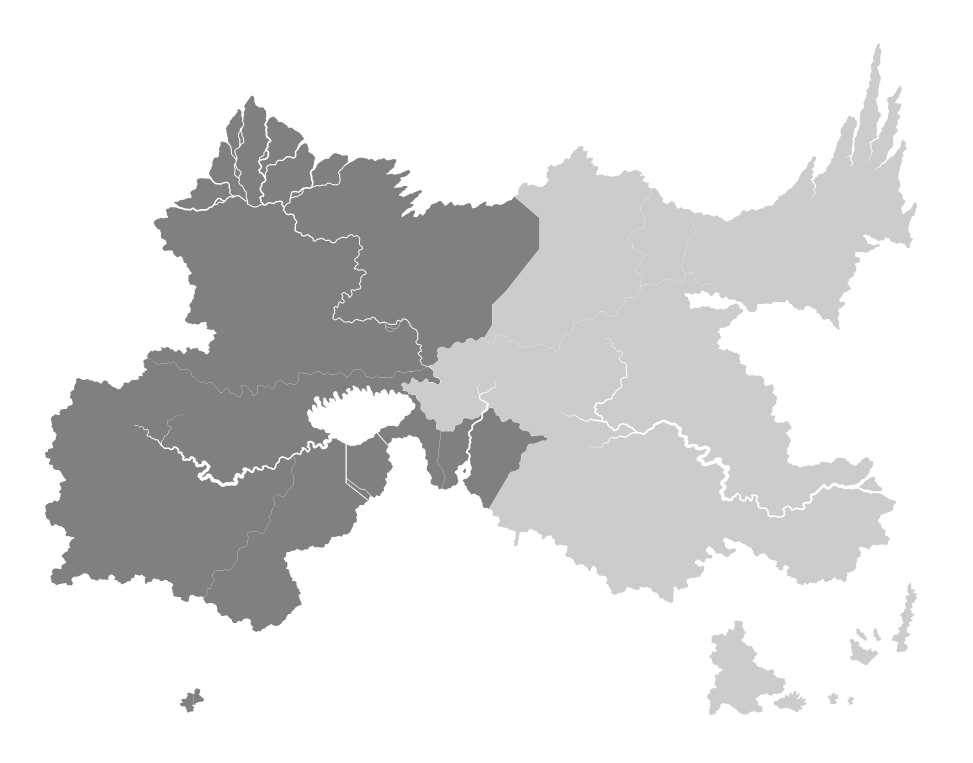
| member states | PRH, Parhovia, Parhana, Erva |
| type | military defence treaty |
Southern Trade Alliance
The Southern Trade Alliance (STA) is a free trade agreement between the nations of Parhovia, Parhana, Erva and Ochor. The Patan Confederacy has applied to join and is currently awaiting review and ruling from the STA council.
The STA was formed as a negotiating point following the cease-fire between Parhovia and Parhana over the island of Pjor, which they had both laid claim to. The brief but bloody conflict was ideologically based, and even thirty years on, reconciliation continues to be a long road.
Erva joined the alliance due to its role in the cease-fire negotiations. Ochor joined five years later.
Minerals, agriculture, aquaculture, financial services and technology are all traded freely across member nations.


| member states | Parhovia, Parhana, Erva, Ochor |
| type | Economic & Trade Agreement |